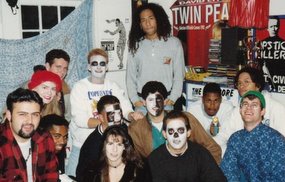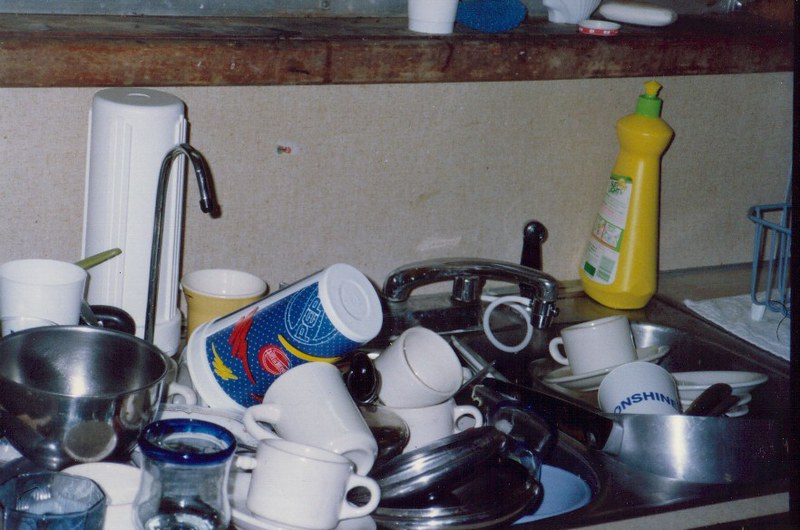

Pink House. 130 North Street. Back In The Day.
Fellow residents from the 1991-94 years were Clint Curtis, Shyam Patel, Raj Krishnasami, Lydia Craft, Jess Deltac, Kyle York Spencer, Caroline Rivers Hall, Mel Lanham, Michelle Sinnott, Jay Murray, N'Gai Wright, Scott Bullock (who crashed on the couch for a year before finally moving in), Bryan Ellerson, Karen Hurka, Sally Stryker, Ryan Mathias, Charlie Speight, Chris Palmatier, Trent McDevitt, and Steve William.

Besides holdovers and returnees Jay, Scott, Mel (& Laverne!), Chris, and N'Gai, residents during 1995-97 included Ian Williams, Greg Humphreys, Allen Sellars (who, like Jay, lived at both the Pink House and 401 Pritchard), Zak Bisacky, James Dasher, Linden Elstran, Jiffer Bourguignon, Grant Tennille (who first made the scene as a fixture in N'Gai's room circa summer '93), Zia Zareem, Ben Folds, Tom Holden, and Chris "Chip" Chapman.
- Erik Ose
Featured Post
Remembering the Pink House, 15 Years Later
2009 marks fifteen years since I graduated from Carolina and moved out of the Pink House, the legendary off-campus crash pad located at 130 ...

Showing posts with label jams. Show all posts
Showing posts with label jams. Show all posts
Thursday, April 27, 1995

Thursday, June 3, 1993
Pink House Jam: Back by Popular Demand

Party flyer designed by Lem Butler.
You really would have enjoyed this party. It was truly a monster jam, with Lem and Reggie splayed across our kitchen counters surrounded by stacks of equipment, speakers, turntables and discs. N'Gai's room was at all times like the eye of the hurricane, populated by a panoply of characters looking for some peace.

Approximately 500-600 revelers turned out, booties were shook, 40's were consumed in mass quantities. Most people couldn't believe there was a keg. The number of fine women was astounding. Malcolm Aaron was there, and Lee Richardson and Chris Miller showed up, but the number of other Alphas was bereft. The only true buzzkill was my having to deal with repeated visits by the police. But the party trickled out around 2 am, before they could come down heavy on us with noise fines, and thus all was fine.

J: Donald Williams was apparently at that party. I didn't see him, though.As per usual with all Pink House parties, there were no outstanding incidents of violence. Somebody punched a hole in one of our walls, but it was one of N'Gai's friends and he later owned up to it. Curiously enough, a similar thing happened when we threw another party the weekend before last. Remember that window that you kicked in once, on the side porch door? Well, another knucklehead busted in the very same pane! Preston Harrison Dunlop, in fact. He came clean amidst profuse apologizing. Obviously, this window has earned its place as a holy knucklectics shrine.
E: He was on the basketball team, right?
J: You must be kidding. He was MVP of the championship in '93, the one who hit all the clutch 3-pointers that put the game away!
- Erik & Jay, 2009
- Letter to Dana
Wednesday, May 5, 1993
Black and white social segregation at UNC-CH
(Editor's note - "The Theoretical Framework Behind Pink House Jams" would have been an appropriate subtitle. This could have been a direct rebuttal to a senior thesis being written around the same time somewhere across town, when its author wasn't hard at work administering the bass-ackwards policies of SBP John Moody, a document later known as How Not To Improve Race Relations on College Campuses.)
Living together and being able to party together - these two things allow people to chill with one another in relaxed, spontaneous, unstructured social situations. After these two developments are facilitated, all other aspects of social integration between people will flow - from eating dinner together at Lenoir, going out in public in interracial groups, studying together, sitting together in class, whatever.
Living together
The South Campus high rises had just been constructed when black students began arriving at UNC-CH in large numbers, during the late 1960's and early 1970's. At this point, many North Campus dorms had not been renovated in decades. The high rises were brand new, and therefore the most appealing dorms for incoming black students to choose to live in. Over the years, the center of Carolina's on-campus black student community has thus been maintained on South Campus.
If unaware of this racially segregated housing dynamic before coming to campus, white and black students quickly find out about it upon arriving as freshmen. New black students face peer pressure from other black students to remain on South Campus. Most white students who choose to live on-campus as upperclassmen gravitate North, whether to be closer to classroom and library facilities or for more race conscious reasons, i.e., to be closer to the center of on-campus "white" student life.
The only official student/administration response to this dynamic in recent years has been the RHA-conceived Residence Hall Diversity Program, in which one hundred eighty or so spaces in the North Campus residence halls are specifically set aside for black students. To date, this program has been a failure. Almost no black students have applied to make the move North.
RHA and the Department of Housing have been so backwards and uncreative about publicizing the program that people hardly know it exists. Those that do resent the program's paternalistic, top-down, imposed from above approach.
What needs to happen at this point in time is for activist black students to take advantage of the program's existence, and organize to make sure every black spot is filled. A void exists that committed leaders could fill, helping lead a movement of black students en masse to North Campus.
Ideally, there should be two established on-campus black communities, on both South and North Campus. To think that there can only be one is short sighted and ultimately, hurts the black student community by making it difficult for black students to enjoy a sense of community anywhere but in the dorms which are the farthest away from classrooms, libraries, the main cafeteria, and the student union.
Besides, the rooms in North Campus residence halls are nicer than ones in the South Campus high rises, they're bigger, and the buildings themselves are surrounded by trees, grassy quads, and the arboretum, instead of parking lots, roads, and traffic.
I lived on South Campus myself my freshman year. The one thing I liked about it was living surrounded by friends of all colors. But Hinton James was a huge, ugly, prison-like building, and it was damn too far to walk.
Partying together
There are few opportunities for black/white social interaction at Carolina. Particularly, it is almost impossible for black and white students to party together.
When black and white students started going to the same nightclub on Franklin Street, Club Zen, on the same nights, the management closed it down.
White frats have fraternity houses, which allow them to throw off-campus parties that white students attend. Black frats have no such fraternity houses. Black frats are only able to throw great hall parties in the student union. Even if black frats had their own houses, however, they would most likely throw jams that would be attended primarily by black students.
Why don't more white students have a love for and appreciation of black music? Why don't more white students attend great hall jams?
The answer has to be seen in terms of why more black students don't attend frat parties. Unless you set social situations up as consciously non-threatening to all participants, and ensure that no unequal power dynamics exist, you can't realistically expect people from different cultures to voluntarily come together. The problem with having social events centered around historically white or black fraternities is that it creates situations where one group is forced to venture onto another group's "turf" in order to participate socially.
It is only normal for both blacks and whites to feel uncomfortable going to a places where members of one group will be indeliably marked as "outsiders." Where discomfort exists, it is not possible for people to chill with one another.
White students also have an advantage in that their social lives include going to off-campus private parties, thrown by white students who live in off-campus houses. Some landlords in town won't rent to black students. But even excluding the racism exhibited by these landlords, vacancies in most off-campus housing is not publicly advertised. Rather, spaces in houses are passed down among friends, year by year. There is nothing deliberately discriminatory about this. However, black students have only been a large scale presence at Carolina since the early seventies, so going back through the years, these patterns of off-campus housing sucession tend to inadvertently benefit white students as a group.
Black students living off-campus are thus largely restricted in their housing choices to apartment complexes. And you can't throw a major jam in a two-bedroom apartment.
Wednesday, July 22, 1992
Great Hall Party after the Black Cultural Awareness Expo

Designed by Lem Butler (Pink House Graphics).
Saturday, September 22, 1990

Subscribe to:
Posts (Atom)